
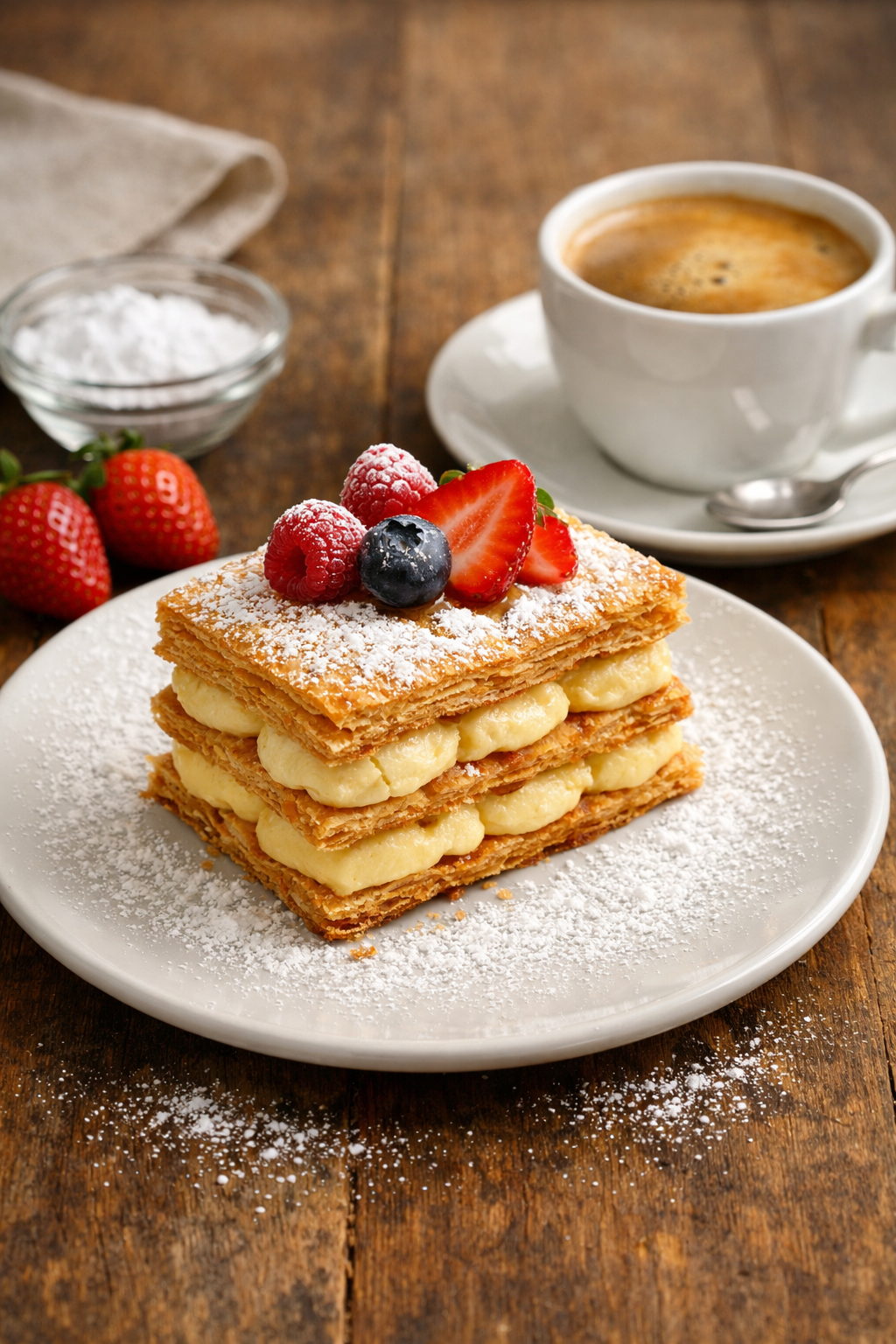
I’ll never forget the first time I tasted millefoglie cake at a small bakery in Rome. The moment my fork cut through those delicate layers, I knew I had found something special. Cream oozed from the sides, and the pastry shattered into a thousand flaky pieces. One bite was all it took to fall completely in love with this Italian masterpiece. Since that day, I’ve made it my mission to learn everything about this incredible dessert and share it with anyone who will listen.
Italian desserts hold a special place in my heart. From tiramisu to panna cotta, each one tells a story of tradition and passion. But millefoglie cake stands out as one of the most elegant and satisfying treats you’ll ever taste. It’s the kind of dessert that turns an ordinary day into a celebration. The combination of crispy pastry and smooth custard creates pure magic in your mouth.
In this article, I’m going to share everything I’ve learned about millefoglie cake over the years. We’ll explore its rich history and what makes it so special in Italian cuisine. I’ll tell you where to buy millefoglie cake if you want to try it right away. And if you’re feeling adventurous, I’ll even show you how to make it at home. Whether you’re searching for millefoglie cake near me or just curious about this dessert, you’re in the right place.
What is Millefoglie Cake?
Millefoglie cake is a classic Italian dessert made of thin layers of crispy puff pastry filled with rich, creamy custard. The name literally means “a thousand leaves” in Italian, which perfectly describes those paper-thin layers of pastry that seem to go on forever. When you cut into a proper millefoglie, you’ll count at least three layers of pastry with two generous layers of custard in between.
This stunning dessert has roots that stretch back centuries in European baking. While the exact origin is debated, most food historians agree that the French and Italians both played major roles in perfecting it. The French call it millefeuille, which also means “a thousand leaves” in their language. You might also hear it called napoleon cake in some parts of the world, though the name has nothing to do with the French emperor.
The beauty of millefoglie lies in its simplicity. You need just a few key ingredients: butter, flour, eggs, milk, and sugar. But turning these basic items into something extraordinary takes skill and patience. The puff pastry must be rolled incredibly thin and baked until it’s golden and crispy. The custard needs to be smooth as silk, not too thick and not too runny. Getting both elements just right is what separates a good millefoglie from a great one.
Each layer of puff pastry in a millefoglie is a work of art. Bakers create puff pastry by folding butter into dough over and over again. This process creates hundreds of tiny layers. When the pastry hits the hot oven, the butter melts and creates steam. That steam pushes the layers apart, making them puff up and turn golden. The result is a pastry so light and crispy it practically melts on your tongue.
The custard filling, known as crema pasticcera in Italian, is what makes this an italian custard cake worth celebrating. Italian pastry chefs take great pride in their custard recipes. They cook egg yolks with milk, sugar, and flour until the mixture thickens to perfection. Some add vanilla for flavor, while others use lemon zest to brighten things up. The custard should be rich but not heavy, sweet but not cloying.
One variation you’ll find in Italy is called millefoglie d’italia. This version celebrates the country by decorating the top with the colors of the Italian flag. Red strawberries, white powdered sugar, and green pistachios create a patriotic and delicious finish. It’s especially popular during national holidays and celebrations. The millefoglie d’italia shows how Italians take a classic dessert and make it their own.
Different regions in Italy put their own spin on this classic. In Naples, you might find a version with pastry cream mixed with ricotta cheese. Some bakeries in Milan add chocolate chips to the custard for extra richness. Northern Italy often tops the cake with sliced almonds, while southern regions prefer a simple dusting of powdered sugar. These regional differences make hunting for the perfect millefoglie an adventure.
The pronunciation of millefoglie trips up many people at first. Here’s how you pronounce millefoglie in Italian: “mee-leh-FOH-lyeh.” The “gli” sound in Italian is soft, almost like the “lli” in the word “million.” Don’t worry if it takes a few tries to get it right. Even Italians appreciate when visitors make an effort to say it correctly. Once you master the pronunciation, ordering this dessert at an Italian bakery becomes much easier.
You might wonder why different cultures call this dessert by different names. The millefeuille version in France is almost identical to the Italian millefoglie. Both use puff pastry and custard. The main differences are minor variations in the custard recipe and decoration. French bakers often top their millefeuille with a distinctive pattern of white and chocolate icing. Italian versions tend to be simpler, letting the quality of the pastry and cream shine through.
So what does millefoglie taste like? Imagine biting into clouds of buttery pastry that shatter into delicate flakes. Then your taste buds meet velvety smooth custard that’s sweet and comforting. The contrast between the crispy pastry and creamy filling is what makes this dessert so special. Each bite offers a perfect balance of textures and flavors. It’s not too sweet, not too rich, just absolutely perfect.
The best millefoglie should be eaten fresh, preferably on the same day it’s assembled. The pastry loses its crispness over time as moisture from the custard seeps in. That’s why many Italian bakeries assemble these cakes to order or make them fresh each morning. If you’re buying one to take home, plan to eat it within a few hours for the best experience.
A millefoglie cake wedding has become increasingly popular in recent years. Couples who want something different from traditional wedding cake choose this elegant Italian dessert. Bakers create stunning multi-tiered versions decorated with fresh flowers and fruits. The individual servings make it easier to serve at large events. Plus, it’s a conversation starter that guests will remember long after the wedding ends.

The History and Pronunciation of Millefoglie Cake
Now that you know what makes this dessert so special, let me take you on a little journey through time. The history of millefoglie cake is actually quite fascinating, and it involves some friendly competition between France and Italy that’s lasted for centuries.
Most culinary historians place the birth of this layered pastry somewhere in the 17th century. Here’s the thing though – both the French and Italians claim to have invented it first. The French point to François Pierre de La Varenne, who published a recipe for something similar in 1651. But the Italians insist that their pastry chefs were already making layered desserts in Italian courts before that. Honestly? I think both countries deserve credit for perfecting this incredible treat.
The real breakthrough came when bakers figured out how to create puff pastry properly. Before modern ovens and precise temperature control, making those delicate layers was incredibly difficult. Pastry chefs had to fold butter into dough dozens of times, creating what seemed like an impossible number of layers. That’s exactly why it’s called millefoglie – those thousand leaves weren’t just poetic license. When you fold dough and butter over and over, you literally create hundreds upon hundreds of paper-thin layers.
By the way, the mathematical reality is pretty mind-blowing. If you fold dough six times, you get 729 layers. One more fold brings you to 1,458 layers. So when Italian bakers named this dessert “mille foglie,” they were being quite literal. Each bite contains an actual thousand leaves of pastry, all stacked together and baked to golden perfection.
The dessert gained massive popularity in Italy during the 18th and 19th centuries. Every major city developed its own version. Rome had one style, Milan another, and Naples created something entirely different. Italian immigrants brought their recipes to America, South America, and other parts of Europe. That’s how this distinctly Italian dessert became a global phenomenon. When I travel, I make it a point to try millefoglie wherever I go, and it’s amazing how each country has adapted it.
Funny enough, the pronunciation still causes confusion even among people who order it regularly. I mentioned earlier how to pronounce millefoglie in Italian, but let me give you some extra tips that helped me master it. The word breaks down into four syllables: mee-leh-FOH-lyeh. The stress falls on the third syllable, that “FOH” part. The final “gli” makes a soft sound, almost like you’re saying “yeh” but with your tongue near the roof of your mouth. Practice it a few times before walking into an Italian bakery, and you’ll sound like a local.
During the Renaissance, this dessert became associated with wealth and sophistication. Making it required expensive butter, refined sugar, and skilled labor. Only the wealthy could afford to serve it at their gatherings. Today, thankfully, it’s much more accessible. You can find it at most Italian bakeries, and some supermarkets even sell frozen versions that you can assemble at home.
Making Your Own Millefoglie Cake
Let me tell you something that might surprise you – making millefoglie at home isn’t as scary as you might think. Yes, it takes time and patience, but the look on people’s faces when you serve them homemade cakes for men or women worth celebrating makes every minute worthwhile.
I’m going to share my favorite chocolate millefoglie recipe because, let’s be honest, everything’s better with chocolate. This version combines traditional Italian technique with a modern chocolate twist that always gets rave reviews at my dinner parties.
For the puff pastry, you have two options. You can make it from scratch, which takes about four hours with all the resting time. Or you can buy high-quality frozen puff pastry from the store. I won’t judge you either way. Even professional pastry chefs sometimes use store-bought puff pastry when they’re short on time. The key is choosing a brand made with real butter, not margarine or oil.
If you decide to make your own puff pastry, you’ll need 2 cups of all-purpose flour, 1 cup of very cold butter, half a cup of ice water, and a teaspoon of salt. The butter needs to be cold enough that it doesn’t melt while you’re working with it. I keep mine in the freezer for 15 minutes before starting. Cut the butter into small cubes and work quickly to incorporate it into the flour. You want pea-sized pieces of butter throughout the dough.
The folding process is where magic happens. Roll your dough into a rectangle, fold it into thirds like a letter, turn it 90 degrees, and roll it out again. Repeat this six times, refrigerating the dough for 30 minutes between every two folds. Yes, it’s tedious. Yes, your kitchen will get messy. But trust me, the results are worth it. The satisfaction of creating those perfect layers rivals any honey cone cake you’ve ever attempted.
Now for the chocolate pastry cream, which is what makes this recipe special. You’ll need 2 cups of whole milk, 4 egg yolks, half a cup of sugar, a quarter cup of cornstarch, 3 ounces of dark chocolate (chopped fine), 2 tablespoons of butter, and a teaspoon of vanilla extract. Heat the milk until it’s just about to boil. Meanwhile, whisk together the egg yolks, sugar, and cornstarch until smooth.
Here’s where timing matters. Pour the hot milk slowly into the egg mixture while whisking constantly. If you dump it all at once, you’ll end up with scrambled eggs instead of smooth custard. Been there, made that mistake more times than I’d like to admit. Pour everything back into the pot and cook over medium heat, stirring constantly. The mixture will suddenly thicken after a few minutes. As soon as it does, remove it from heat and stir in the chocolate, butter, and vanilla.
The assembly is actually the fun part. Roll out your puff pastry very thin – about an eighth of an inch thick. Cut it into three equal rectangles that fit your serving platter. Prick the pastry all over with a fork to prevent it from puffing up too much in the oven. This is important because you want relatively flat layers, not giant puffy pillows of pastry.
Bake the pastry at 400°F for about 15 minutes until it’s golden brown and crispy. Let it cool completely before assembling. This is crucial because if you add custard to warm pastry, everything will turn into a soggy mess. I usually bake my pastry the night before and store it in an airtight container. Similar to when you’re making a special cake with wishes written on it, presentation matters tremendously with millefoglie.
To assemble, place one pastry layer on your serving plate. Spread half the chocolate custard evenly across it, leaving a small border around the edges. Top with the second pastry layer, then the remaining custard, and finally the third pastry layer. Dust the top generously with powdered sugar or, if you’re feeling fancy, drizzle some melted chocolate in a decorative pattern.
Want some variations to try? Replace the chocolate custard with classic vanilla pastry cream and fresh strawberries. Or make a pistachio version using ground pistachios in your custard. I’ve even made a coffee version by adding two tablespoons of espresso powder to the custard – it tastes like billionaires and chocolate cake had a sophisticated Italian cousin.
One tip that changed everything for me: refrigerate your assembled millefoglie for at least two hours before serving. This helps the custard set properly and makes cutting clean slices much easier. Use a serrated knife and wipe it clean between each cut. The layers will still shatter a bit when you cut them, but that’s part of the charm.
For fruits, raspberries work beautifully between the layers. So do thinly sliced peaches in summer or poached pears in winter. Just make sure any fruit you add is well-drained so it doesn’t make the pastry soggy. I learned that lesson the hard way when I got too enthusiastic with fresh berries and ended up with a delicious but structurally challenged dessert.
Where to Buy Millefoglie Cake
Okay, so you’re convinced you need to try this amazing dessert. I get it. Sometimes making it from scratch just isn’t in the cards, and you want to taste the real deal made by someone who’s been perfecting their recipe for years. The good news? Finding a great millefoglie isn’t as hard as you might think, though the quality can vary wildly depending on where you look.
When I’m searching for millefoglie cake near me, I always start with authentic Italian bakeries in my area. These are the places where you’ll find bakers who grew up learning these recipes from their nonnas. They understand that the pastry needs to shatter when you bite it, and the custard should taste like it came straight from an Italian grandmother’s kitchen. In major cities like New York, Boston, Chicago, or San Francisco, you’ll find several authentic options. Even smaller towns often have at least one Italian bakery that takes pride in their traditional desserts.
Here’s my strategy for finding the best spot: walk in and look at the millefoglie first. The layers should be visible and distinct. If everything looks mushy or if the custard has soaked through the pastry completely, keep walking. A good bakery assembles these cakes fresh daily or even to order. Don’t be shy about asking when they made it. Any respectable Italian baker will be proud to tell you it was assembled that morning.
For those of you who don’t live near an Italian neighborhood, several high-end grocery stores now carry millefoglie or similar layered pastries. Whole Foods, for instance, sometimes has them in their bakery section, though they might call it by the French name millefeuille. Trader Joe’s occasionally sells frozen puff pastry desserts that you can assemble yourself. They’re not quite as good as the real thing, but they’ll give you a taste of what this dessert is all about.
Online ordering has become a game-changer for dessert lovers. Several Italian bakeries now ship their pastries across the country. Ferrara Bakery in New York’s Little Italy has been making millefoglie since 1892, and they ship nationwide. Veniero’s, another New York institution, also offers shipping. I ordered from them last Christmas and was amazed at how well the pastry held up during transit. They ship the components separately, so you assemble it at home, which means the pastry stays crispy.
Goldbelly is another fantastic resource for finding authentic Italian desserts. This platform connects you with bakeries from all over the country. I’ve used it to order millefoglie from a small bakery in Boston’s North End that I discovered during a work trip. Being able to get that same incredible dessert delivered to my door in California felt like magic. The prices are higher than buying local, obviously, but sometimes you just need that specific taste.
European grocers and specialty shops are hidden gems for finding where to buy millefoglie cake. These stores often carry frozen versions imported directly from Italy. While purists might turn their noses up at frozen desserts, I’ve had some surprisingly good ones. The key is following the defrosting instructions carefully and serving it quickly once it’s ready. Don’t let it sit around for hours, or you’ll lose that crucial textural contrast.
By the way, if you’re traveling in Italy, every pasticceria will have their version. In Rome, I always stop at Regoli near the Colosseum. Their millefoglie is extraordinary, with extra-thick layers of custard that somehow don’t overwhelm the delicate pastry. In Milan, Pasticceria Marchesi has a version that includes a hint of amaretto in the custard. Each region brings something special to the table, which makes bakery-hopping in Italy one of my favorite activities.
Millefoglie Cake for Special Occasions
Let me tell you about the first millefoglie cake wedding I attended. My friend Isabella, who’s half-Italian, decided she wanted something different from the standard American wedding cake. She worked with a local Italian bakery to create a stunning three-tier millefoglie decorated with fresh roses and edible gold leaf. When they cut into it during the reception, people gasped at those perfect layers. Every single guest was talking about that cake for months afterward.
The beauty of millefoglie for weddings is its versatility. You can keep it traditional with vanilla custard and powdered sugar, or get creative with flavors that reflect your personality. One couple I know did a tier with chocolate custard, another with lemon custard, and a third with strawberry. Guests could choose their favorite, which made everyone happy. Plus, it’s easier to cut and serve than traditional fondant-covered cakes that require special techniques.
Birthday celebrations are another perfect occasion for this elegant dessert. Last year, I ordered a small millefoglie for my mother’s 70th birthday instead of a traditional cake. The bakery decorated the top with fresh berries and a “70” made from spun sugar. She loved it so much that she’s requested it every year since. The individual slice approach also works great for birthdays because you can order exactly the number of servings you need without waste.
Customizing millefoglie for specific themes is easier than you might think. For a baby shower, ask the bakery to use pastel-colored macarons as decoration. For a graduation party, school colors can be incorporated through fruit choices or colored icing drizzles. I’ve seen versions decorated with everything from fresh flowers to chocolate shavings to candied nuts. The neutral canvas of the pastry layers accepts almost any decoration beautifully.
Anniversary celebrations deserve something special, and millefoglie delivers. Many Italian bakeries will create custom decorations using chocolate plaques with messages or dates. You can also request specific flavor combinations that have meaning to you as a couple. If you had your first date at an Italian restaurant where you shared tiramisu, why not incorporate coffee and mascarpone into your anniversary millefoglie?
Holiday gatherings become more memorable with this impressive dessert on the table. For Christmas, I’ve seen versions decorated with sugared cranberries and rosemary sprigs that look like tiny Christmas trees. Easter millefoglie might feature pastel-colored cream layers and spring flowers. The Fourth of July practically demands the millefoglie d’italia treatment with red strawberries, white cream, and blueberries creating a patriotic display.
Office celebrations and corporate events are another great venue for millefoglie. It’s sophisticated enough for important clients but approachable enough that everyone will enjoy it. I once brought a large millefoglie to a team meeting instead of donuts, and my coworkers still bring it up years later. It showed effort and thoughtfulness while introducing people to something they might never have tried otherwise.
If you’re ordering for an event, here’s what I’ve learned: order more than you think you need. People will want seconds once they taste it. A standard serving is about a 3-inch slice, but many people will go back for another taste. I typically calculate 1.5 servings per person for a dessert-only event. Also, keep in mind the calorie content can be significant with all that butter and cream, so it’s worth having some lighter options available too, though honestly, this is a special occasion we’re talking about.
Working with your bakery on custom orders requires some advance planning. Most places need at least a week’s notice for special orders, and popular bakeries might need even more time during busy seasons. Don’t be afraid to schedule a tasting appointment. Any good bakery will let you sample their custard and pastry before committing to a large order. This also gives you a chance to discuss exactly what you want and make sure you’re all on the same page.
Transportation is something people often forget about until the last minute. Millefoglie is delicate, especially when freshly assembled. If you’re picking it up yourself, make sure you have a flat, stable surface in your car. I use a non-slip mat and drive extra carefully, avoiding sudden stops. Some bakeries offer delivery for special orders, which takes the stress off you completely. It’s worth the extra fee for peace of mind.
Price-wise, expect to pay more for millefoglie than for standard cakes. The labor involved in creating those layers and making fresh custard justifies the cost. A small millefoglie serving 6-8 people typically runs $40-60 at quality bakeries. Wedding-sized versions can cost several hundred dollars, though still often less than elaborate fondant creations. Consider it an investment in creating an unforgettable experience for your guests.
One last tip for special occasions: photograph the cake before cutting into it. I know everyone’s eager to dig in, but those layers look absolutely stunning in photos. The cross-section of a well-made millefoglie is Instagram gold. Plus, you’ll want to remember how beautiful it looked before everyone devoured it in about fifteen minutes flat.
If you’re planning any celebration and want more inspiration for impressive desserts, you’ll find tons of creative ideas in our cakes and cupcakes collection that pair wonderfully with Italian themes and elegant gatherings.
Whether you’re celebrating something huge or just want to make a random Tuesday special, millefoglie brings a touch of Italian elegance to any table. The effort of finding a great bakery or making one yourself pays off when you see people’s faces light up at that first bite. Life’s too short for boring desserts, so treat yourself and the people you love to something truly special.
FAQ Section
What is millefoglie cake?
Millefoglie cake is a classic Italian dessert consisting of thin, crispy layers of puff pastry alternated with smooth pastry cream or custard. The name translates to “a thousand leaves” in Italian, referring to the many delicate layers created during the pastry-making process. Typically, you’ll find three layers of pastry with two layers of custard in between, though some versions have more. It’s similar to the French millefeuille and sometimes called napoleon cake in English-speaking countries. The dessert is known for its elegant appearance and wonderful contrast between crispy and creamy textures.
What does millefoglie taste like?
Millefoglie offers a delightful combination of buttery, flaky pastry and sweet, creamy custard. The puff pastry has a rich, slightly salty flavor from the butter and shatters into delicate, crispy flakes when you bite into it. The custard filling is smooth and sweet, often flavored with vanilla, though chocolate, coffee, or citrus variations exist. The overall taste is indulgent but not overly heavy, with a perfect balance between the crispy and creamy components. Each bite gives you that satisfying crunch followed by velvety smoothness that makes this dessert so addictive.
How do you pronounce millefoglie in Italian?
Millefoglie is pronounced “mee-leh-FOH-lyeh” in Italian. Break it into four syllables with the emphasis on the third syllable (FOH). The tricky part for English speakers is the “gli” combination, which creates a soft sound similar to the “lli” in “million.” Your tongue should touch near the roof of your mouth when making this sound. Practice saying each syllable slowly, then speed up until it flows naturally. Most Italians appreciate when visitors try to pronounce it correctly, even if you don’t get it perfect on the first try.
Why is it called millefoglie?
The name millefoglie literally means “a thousand leaves” in Italian, which describes the many thin layers created in the puff pastry. When bakers fold butter into dough repeatedly during the pastry-making process, they create hundreds of distinct layers that separate during baking. After six folds, you have 729 layers, and one more fold brings you to 1,458 layers. So the name isn’t just poetic—it’s actually quite accurate. These layers look like delicate leaves stacked on top of each other, which inspired the beautiful name that’s been used for centuries.
Can I make millefoglie ahead of time?
You can prepare the components ahead of time, but I strongly recommend assembling millefoglie close to serving time. The puff pastry can be baked a day in advance and stored in an airtight container to maintain crispness. The custard can also be made up to two days ahead and kept refrigerated. However, once you assemble the layers, the moisture from the custard will gradually soften the pastry. For the best texture, assemble it no more than 2-4 hours before serving. If you must prepare it earlier, expect some loss of that perfect crispy-creamy contrast.
What’s the difference between millefoglie and millefeuille?
Millefoglie and millefeuille are essentially the same dessert with minor cultural variations. Both names mean “a thousand leaves” in Italian and French respectively, and both use puff pastry with custard filling. The main differences are in decoration and slight variations in the custard recipe. French millefeuille traditionally features a distinctive white and chocolate icing pattern on top, while Italian millefoglie is often simply dusted with powdered sugar. French versions might use a slightly different pastry cream consistency. These are subtle differences, and both versions are absolutely delicious.
How many calories are in a slice of millefoglie?
A typical slice of millefoglie (about 3-4 inches) contains approximately 300-400 calories, though this varies based on size and ingredients used. The puff pastry contributes significant calories due to its high butter content, and the custard adds more from eggs, milk, and sugar. Chocolate or other additions will increase the calorie count further. While it’s definitely an indulgent treat, enjoying it on special occasions is part of appreciating good food. If you’re watching your intake, consider sharing a slice or saving it for celebrations when you can truly savor it without guilt.
Can I freeze millefoglie cake?
I don’t recommend freezing assembled millefoglie because the texture suffers significantly when thawed. The custard can separate and become grainy, while the pastry loses its crispness and becomes soggy. However, you can freeze the unbaked puff pastry dough very successfully for up to three months. Some people freeze baked pastry layers, though they’ll need crisping in the oven after thawing. If you must freeze a finished millefoglie, know that it will be edible but won’t have that magical texture contrast that makes this dessert special. Fresh is always best with this particular cake.
What can I substitute for pastry cream in millefoglie?
While traditional pastry cream is classic, several alternatives work beautifully in millefoglie. Whipped cream mixed with mascarpone cheese creates a lighter, less sweet filling that many people love. Chocolate ganache offers a rich, decadent option for chocolate lovers. Lemon curd provides a bright, tangy contrast to the buttery pastry. Some bakers use ricotta cream mixed with sugar and vanilla for an authentic Italian variation. You could even use fresh fruit with whipped cream for a summery version. Whatever filling you choose, make sure it’s thick enough that it won’t make the pastry soggy.
Why did my millefoglie turn soggy?
Soggy millefoglie usually results from assembling it too far in advance or using custard that’s too thin or still warm. The moisture from the cream gradually seeps into the pastry, softening those crispy layers. To prevent this, always let both the pastry and custard cool completely before assembly. Make sure your custard is thick enough to hold its shape when spread. Assemble the cake as close to serving time as possible, ideally within 2-4 hours. Also, ensure your baked pastry is completely crispy before using it—if it’s at all soft or underbaked, it will absorb moisture even faster.
Equipment
- Rolling Pin
- Mixing Bowl
- Fork
- Baking Sheet
- Whisk
Ingredients
- 2 cup all-purpose flour for puff pastry
- 1 cup very cold butter for puff pastry
- ½ cup ice water for puff pastry
- 1 teaspoon salt for puff pastry
- 2 cup whole milk for chocolate custard
- 4 egg yolks for chocolate custard
- ½ cup sugar for chocolate custard
- ¼ cup cornstarch for chocolate custard
- 3 ounce dark chocolate chopped fine, for chocolate custard
- 2 tablespoon butter for chocolate custard
- 1 teaspoon vanilla extract for chocolate custard
- q.s. powdered sugar for dusting
Instructions
- For the puff pastry, cut cold butter into small cubes and combine with flour and salt.
- Add ice water and mix until pea-sized dots of butter are mixed into the dough.
- Roll the dough into a rectangle, fold into thirds, and refrigerate for 30 minutes.
- Repeat the rolling and folding process six times, refrigerating every two folds.
- For the chocolate custard, heat milk until almost boiling.
- Whisk together egg yolks, sugar, and cornstarch in a bowl until smooth.
- Slowly pour the hot milk into the egg mixture while whisking constantly.
- Return the mixture to the pot and cook over medium heat until thickened.
- Stir in chopped chocolate, butter, and vanilla until smooth.
- Roll out puff pastry to an eighth of an inch thick and cut into three equal rectangles.
- Prick the pastry with a fork to prevent puffing.
- Bake at 400°F for about 15 minutes, or until golden brown and crispy.
- Let the baked pastry cool completely before assembly.
- Place one pastry layer on a serving plate and spread half of the chocolate custard on top.
- Add the second pastry layer, followed by the remaining custard.
- Top with the last pastry layer, then dust with powdered sugar or drizzle with melted chocolate.
- Refrigerate assembled millefoglie for at least 2 hours before serving.
Notes
Nutrition

Hello! I’m Sarah Mitchell, and I’m passionate about bringing creativity and innovation to baking. My love for baking started in high school when I first tried my hand at decorating cupcakes for a class project. What began as a fun hobby quickly became a full-time passion. I’ve spent the past decade working in bakeries and dessert shops, honing my skills in everything from simple cookies to intricate wedding cakes.
After working in some of the top bakeries across the country, I realized that baking was about more than just following recipes — it was about infusing your personality into each creation. At BakingSecret.com, I love creating recipes that push boundaries while staying true to the heart of classic baking. I specialize in creating delicious and visually stunning pastries that will wow your guests.
When I’m not baking, I enjoy teaching baking classes, trying out new cake decoration techniques, and traveling to find inspiration in global dessert traditions. I’m so excited to share my tips and tricks with you to help elevate your baking game!