
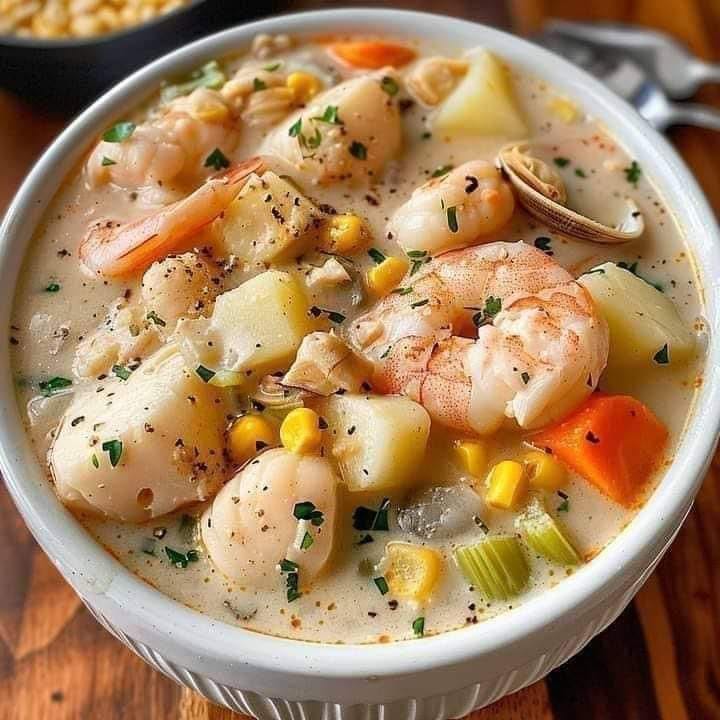
There’s something magical about a pot of homemade soup simmering on the stove, isn’t there? But a truly exceptional Seafood Chowder is more than just soup—it’s a warm, creamy hug in a bowl that brings the taste of the ocean right to your kitchen table. This recipe for Delicious Seafood Chowder is my go-to for chilly nights, a special gathering, or whenever I need to impress someone with very little effort. Let’s make some magic together!
The Story of Seafood Chowder: From Ship to Shore
Chowder has a rich history as a fisherman’s stew, born out of necessity and ingenuity. Sailors would toss the day’s catch into a pot with hardtack biscuits, salt pork, and whatever vegetables they had. Our modern Delicious Seafood Chowder is a much more luxurious descendant of those humble meals! My version draws inspiration from New England-style chowders but uses a lighter touch with herbs and seasoning. I tested this recipe over three family dinners, finally perfecting the balance of creaminess and seafood flavor that had everyone asking for seconds. The secret? It’s all in the broth and the order you add things!
Why You’ll Love This Delicious Seafood Chowder
Let me count the ways! First, the flavor is deeply satisfying, with sweet seafood, savory vegetables, and a rich, creamy base. Second, it’s incredibly versatile—use whatever fresh seafood you find. Third, it makes you look like a kitchen rockstar, but it’s surprisingly simple. It’s a one-pot wonder that feels fancy but is built on easy techniques. Perfect for both a quiet Tuesday and a festive dinner party.
Perfect Occasions for This Cozy Chowder
This chowder is your secret weapon for so many events! Serve it in big mugs for a casual movie night. It’s a stunning first course for a holiday meal like Christmas Eve. Bring it to a potluck in a slow cooker to keep it warm—it’s always a hit. I also love making a big batch on a Sunday to have comforting lunches all week long.
Ingredients for Your Delicious Seafood Chowder
Here’s what you’ll need to gather. Don’t worry if you’re missing an item; I’ve got substitution ideas coming right up!
- 1/2 cup butter
- 1 medium onion, diced
- 3 cloves garlic, minced
- 2 celery stalks, diced
- 2 medium potatoes, peeled and cubed
- 1 teaspoon Old Bay seasoning
- 1/2 teaspoon dried thyme
- 1/4 cup all-purpose flour
- 4 cups seafood stock or chicken broth
- 1 bay leaf
- 1 cup corn kernels (fresh or frozen)
- 1 pound mixed seafood (like shrimp, scallops, and firm white fish), cut into bite-sized pieces
- 1 cup heavy cream or half-and-half
- Salt and freshly ground black pepper to taste
- Fresh parsley, chopped for garnish
Handy Substitution Options
- Seafood: No scallops? Use all shrimp and fish. Canned clams (with their juice!) are a fantastic pantry standby.
- Dairy: For a lighter chowder, use whole milk instead of cream. It will be less rich but still delicious.
- Gluten-Free: Swap the all-purpose flour with a 1:1 gluten-free flour blend or use cornstarch (mix with a little cold water first).
- Herbs: Fresh thyme is wonderful! Use 1 teaspoon of fresh leaves if you have it.
Let’s Make This Creamy Seafood Chowder!
Step 1: Build Your Flavor Foundation
Melt the butter in a large, heavy-bottomed pot or Dutch oven over medium heat. Once it’s foamy, add the diced onion, celery, and a pinch of salt. The smell is already amazing! Cook for about 5-7 minutes, stirring often. You want the vegetables to become soft and translucent, but not browned. This gentle cooking process, called sweating, builds a sweet and savory base for your entire chowder. Pro tip: Don’t rush this step. Letting the onions soften fully prevents any harsh raw flavor later.
Step 2: Create the Roux and Broth
Sprinkle the flour over the cooked vegetables. Stir constantly for about 2 minutes. You’ll see the flour coat everything and cook into a pale blonde paste—this is your roux. It’s what will thicken your chowder beautifully. Now, slowly pour in the seafood stock while whisking continuously. This prevents any lumps from forming. Add the cubed potatoes, Old Bay seasoning, thyme, and the bay leaf. Bring everything to a simmer, then reduce the heat. Let it cook for 15-20 minutes, until the potatoes are just tender when pierced with a fork.
Step 3: The Grand Seafood Finale
Add the corn and your mixed seafood to the pot. Seafood cooks very quickly. Gently stir and simmer for just 4-5 minutes. You’ll see the shrimp turn pink and the fish become opaque. Overcooking makes seafood rubbery, so be vigilant! Once the seafood is just done, turn the heat down to low. Slowly stir in the heavy cream. Warm it through but do not let it boil, as high heat can cause the cream to separate. Taste her! This is the moment. Season generously with salt and freshly cracked black pepper. Chef’s tip: For an extra layer of flavor, add a splash of dry sherry or a squeeze of lemon juice with the cream.
Timing Your Perfect Chowder
Prep Time: 20 minutes
Cook Time: 30 minutes
Total Time: About 50 minutes
Resting Time: Let it sit for 5-10 minutes off the heat before serving to allow flavors to meld.
Chef’s Secret for the Best Seafood Chowder
Use cold butter when you start. Melting cold butter slowly helps create a more stable base for your roux, which leads to a smoother, silkier final chowder. It’s a small detail that makes a big difference in texture!
A Little Extra Chowder Info
The name “chowder” likely comes from the French word for pot, “chaudière.” Fishermen would bring their catch back to shore in these large pots, and the communal meal cooked inside took on the name. So when you make this, you’re part of a long, delicious tradition of sharing good food from the sea.
Necessary Equipment
- A large Dutch oven or heavy-bottomed soup pot
- Sharp chopping knife and cutting board
- Wooden spoon or silicone spatula
- Ladle for serving
- Measuring cups and spoons
Storing Your Leftover Seafood Chowder
Let the chowder cool completely before storing. Transfer it to an airtight container. It will keep in the refrigerator for up to 3 days. The flavors often deepen and improve overnight!
To reheat, place the desired amount in a saucepan over low heat. Stir gently until warmed through. Avoid boiling to keep the seafood tender and the cream from separating. If the chowder has thickened too much, you can thin it with a small splash of broth or milk.
This chowder can be frozen, but be aware the cream-based broth may separate slightly when thawed. For best results, freeze for up to 2 months. Thaw overnight in the fridge and reheat slowly on the stove, whisking well to recombine.
Tips and Advice for Chowder Success
- Fresh is best, but frozen works: High-quality frozen seafood is a fantastic option. Thaw it in the fridge overnight and pat it dry before using.
- Season in layers: Add a little salt when cooking the vegetables, and always do a final taste at the end. The seafood stock may already be salty.
- Bacon bonus: For a smoky twist, cook 4 slices of diced bacon first, remove them, and use the bacon fat to cook your vegetables. Sprinkle the cooked bacon on top as a garnish.
Presentation Tips to Impress Your Guests
- Serve in warm, shallow bowls to keep the chowder hot longer.
- Top with a sprinkle of fresh parsley, a crack of black pepper, and a small pat of butter for a glossy finish.
- Offer oyster crackers or crusty bread on the side for dipping. A warm, buttery roll is pure heaven with this.
Healthier & Fun Chowder Variations
Love this base recipe? Try these six tasty twists!
- Manhattan-Style Chowder: Swap the cream for diced tomatoes and extra broth. It’s a tomato-based, lighter version that’s tangy and refreshing.
- Corn and Crab Chowder: Use lump crabmeat as your main seafood and double the corn. Sweet crab and sweet corn are a match made in heaven.
- Spicy Cajun Chowder: Replace the Old Bay with Cajun seasoning. Add diced andouille sausage with the vegetables for a kick.
- New England Clam Chowder: Use chopped clams (and their juice!) as your primary seafood. Keep it classic and creamy.
- Low-Carb “Chowder”: Omit the potatoes and flour. Thicken the broth with a slurry of xanthan gum or use puréed cauliflower for a creamy, veggie-packed base.
- Salmon and Dill Chowder: Use flaky salmon as your fish and add a big handful of fresh dill at the very end. It’s bright, elegant, and so flavorful.
Making a cozy soup like this always puts me in the mood for baking something sweet afterwards. If you’re the same, you must try my decadent Hershey Chocolate Cake for the ultimate comfort food combo. For a lighter fruity dessert, this stunning Milk Cream and Strawberry Jelly Roll Cake is a showstopper. And if you love easy loaf cakes as much as I do, my Cranberry Orange Loaf Cake or the malted chocolate goodness of a Maltesers Loaf Cake are always a hit with my friends.
Common Mistakes to Avoid
Mistake 1: Adding All the Seafood at Once
Throwing your delicate shrimp, scallops, and fish into the pot at the same time as the potatoes is a recipe for rubbery, overcooked seafood. Different types and sizes cook at slightly different rates. To avoid this, always add your seafood last. Simmer just until everything is opaque and cooked through, which usually only takes 4-6 minutes. Your seafood should be tender and sweet, not tough.
Mistake 2: Letting the Chowder Boil After Adding Cream
A rolling boil is the enemy of a creamy, smooth chowder. High heat can cause the dairy to “break” or curdle, creating a grainy texture and a slick of fat on the surface. After you stir in the cream or half-and-half, only warm the chowder gently over low heat. You want it hot and steaming, but not bubbling. If you see bubbles, immediately take it off the heat.
Mistake 3: Not Tasting Before Serving
This soup needs layers of seasoning! The base vegetables need salt to bring out their sweetness. The stock varies in saltiness. And the final touch of pepper and salt at the end is what makes all the flavors pop. Skipping the final taste test often leaves you with a bland chowder. Always, always taste and adjust the seasoning right before you ladle it into bowls.
Mistake 4: Over-Thickening with Flour
It’s easy to get carried away with the roux, thinking more flour equals a thicker chowder. Too much flour can make your soup taste pasty and gluey. The ratio in this recipe is perfect for a rich, coat-the-spoon consistency. Remember, the chowder will also thicken slightly as it cools. If it does get too thick, you can easily thin it with a little extra broth or milk when reheating.
Frequently Asked Questions
Can I make this chowder ahead of time?
Yes, you can prepare it a day in advance with great results. For the best texture, follow the recipe but stop right before adding the seafood and cream. Let the potato-vegetable base cool and store it in the fridge. When you’re ready to serve, reheat the base to a simmer, then proceed with adding the seafood and cream. This prevents the seafood from overcooking and the cream from breaking during storage and reheating.
What is the best seafood mix to use?
You want a mix of textures and flavors for a truly memorable chowder. A great combination is medium shrimp, bay scallops, and a firm white fish like cod or halibut. You can also add mussels or clams in the shell for a dramatic presentation—just be sure to scrub them well. Using a mix prevents the flavor from being one-note and makes every spoonful interesting. Fresh or high-quality frozen seafood both work wonderfully.
My chowder is too thin. How can I thicken it?
Don’t worry, this is an easy fix! Make a simple slurry by mixing one tablespoon of cornstarch with two tablespoons of cold water in a small bowl until smooth. While your chowder is simmering, slowly whisk in the slurry. Let it cook for 2-3 minutes, and it will thicken up nicely. You can also make a beurre manié: mash equal parts soft butter and flour into a paste and whisk small bits into the hot chowder until it reaches your desired consistency.
Can I use milk instead of heavy cream?
Absolutely. Using whole milk or half-and-half will create a lighter, but still creamy, chowder. The final result won’t be as luxuriously rich and thick, but it will be delicious and a bit healthier. Be extra careful not to let it boil if using milk, as it can separate more easily than cream. The key is gentle heating once the dairy is added.
How long does seafood chowder last in the fridge?
Properly stored in an airtight container, your homemade seafood chowder will stay fresh and safe to eat for up to 3 days in the refrigerator. The flavors often blend and improve after a day. Always reheat it gently on the stovetop, and give it a good stir before serving. If it smells sour or off at all, it’s best to discard it.
Is it okay to freeze seafood chowder?
You can freeze it, but with a caution. Cream-based soups can sometimes separate or become grainy when thawed and reheated. For the best frozen results, you might prepare the base (with vegetables, potatoes, and broth) and freeze that. Then, add fresh seafood and cream when you thaw and reheat it. If freezing the complete chowder, consume it within 2 months and reheat slowly, stirring well to re-emulsify.
What can I substitute for Old Bay seasoning?
If you don’t have Old Bay, you can make a quick substitute. Mix together 1/2 teaspoon celery salt, 1/4 teaspoon paprika, a pinch of black pepper, a pinch of dry mustard, and a tiny pinch of ground cloves or allspice. This will give you a similar savory, slightly spicy, and aromatic flavor profile that works perfectly in seafood dishes.
Why did my chowder turn out lumpy?
Lumps usually form when the flour is not properly incorporated into the fat before adding liquid. To avoid this, make sure you cook the flour-and-butter roux for a full minute or two, stirring constantly. Then, when adding the stock, do so slowly while whisking vigorously. This ensures the liquid integrates smoothly with the roux. If you do get lumps, you can use an immersion blender briefly on the base before adding seafood, or strain it.
What sides go best with seafood chowder?
This chowder is a meal in itself, but a few simple sides make it perfect. A crisp green salad with a tangy vinaigrette cuts through the richness. Warm, crusty bread, garlic bread, or classic oyster crackers are essential for dipping. For a heartier meal, a simple grilled cheese sandwich turns it into the ultimate comfort food feast.
Can I make this in a slow cooker?
You can adapt this recipe for a slow cooker, but add the seafood and dairy at the very end. Sauté the onions, celery, and garlic on the stove, then transfer them to the slow cooker with the potatoes, seasonings, and broth. Cook on low for 6-7 hours or high for 3-4, until potatoes are tender. About 30 minutes before serving, stir in the seafood and cream, and cook on high until the seafood is done. This prevents overcooking.
I hope this recipe brings as much warmth and joy to your table as it does to mine. There’s nothing quite like sharing a bowl of something made with love. For more comforting recipes just like this, from savory dinners to sweet treats, explore all our ideas over on our main recipes page. Happy cooking!
So there you have it—your new favorite recipe for a comforting, impressive, and utterly Delicious Seafood Chowder. It’s proof that with a few simple ingredients and a little patience, you can create a restaurant-quality meal right at home. Don’t forget that proper food preparation techniques, like making a good roux and seasoning in layers, are the real secrets to amazing flavor. Now, go grab that big pot, and let’s get cooking. Your family and friends are going to thank you!
Equipment
- Grand pot
- Couteau bien aiguisé
- Spatule en bois ou en silicone
- Louche
- Tasses et cuillères à mesurer
Ingredients
- 1/2 tasse beurre
- 1 moyen oignon, haché
- 3 gousses ail, émincées
- 2 tiges céleri, haché
- 2 moyens pommes de terre, pelées et coupées en dés
- 1 cuil. à café assaisonnement Old Bay
- 1/2 cuil. à café thym séché
- 1/4 tasse farine tout usage
- 4 tasses bouillon de fruits de mer ou bouillon de poulet
- 1 feuille feuille de laurier
- 1 tasse grains de maïs (frais ou congelés)
- 1 livre mélange de fruits de mer (comme des crevettes, des coquilles Saint-Jacques et du poisson blanc ferme), coupé en morceaux
- 1 tasse crème épaisse ou crème légère
- q.s. sel et poivre noir fraîchement moulu au goût
- q.s. persil frais, haché pour la garniture
Instructions
- Faites fondre le beurre dans une grande casserole à feu moyen et ajoutez l'oignon haché, le céleri et une pincée de sel. Faites cuire jusqu'à ce qu'ils soient tendres et translucides, environ 5 à 7 minutes.
- Parsemez la farine sur les légumes cuits et remuez pendant environ 2 minutes pour former un roux.
- Versez lentement le bouillon de fruits de mer tout en fouettant continuellement.
- Ajoutez les pommes de terre en dés, l'assaisonnement Old Bay, le thym et la feuille de laurier. Portez à ébullition puis réduisez le feu, faites cuire 15 à 20 minutes jusqu'à ce que les pommes de terre soient tendres.
- Incorporez le maïs et le mélange de fruits de mer, en cuisant pendant 4 à 5 minutes jusqu'à ce que les fruits de mer soient cuits.
- Réduisez le feu au minimum et incorporez doucement la crème épaisse, tiède mais ne laissez pas bouillir. Assaisonnez avec du sel et du poivre au goût.
Notes
Nutrition

Hi, I’m Olivia Parker, the founder of BakingSecret.com and a lifelong lover of all things sweet and homemade. I grew up in a small town in Oregon, where the smell of fresh cookies in my family’s kitchen sparked my passion for baking. Over the years, I turned that passion into a mission: to help home bakers feel confident, inspired, and creative.
After studying food science and working in several artisan bakeries across the U.S., I decided to create a space where everyone from beginners to seasoned bakers can find reliable recipes, expert tips, and a warm, welcoming community. BakingSecret.com is my way of sharing the magic of baking with the world. When I’m not testing new recipes, you’ll find me exploring farmers’ markets, collecting vintage cookbooks, or perfecting my sourdough technique.