Welcome to My Moon Cake Journey
I still remember the first time I bit into a moon cake. I was seven years old, sitting at my grandmother’s dining table in late September. The golden pastry felt heavy in my small hands. The sweet lotus paste and salty egg yolk created a flavor combination that confused and delighted my young taste buds at the same time. My grandmother smiled and told me stories about the Moon Festival while I nibbled carefully around the edges.
That moment changed everything for me. Moon cakes became more than just a sweet treat. They represented family gatherings, cultural heritage, and the changing of seasons. Now, years later, I want to share that same magic with you through this blog.
The moon cake holds a special place in Chinese culture. These round pastries symbolize family unity and completeness. People exchange them during the Mid-Autumn Festival, also called the moon cake festival, which falls on the 15th day of the eighth lunar month. Families gather under the full moon, sharing these treats while celebrating the harvest and togetherness.
In this article, I will walk you through the wonderful world of moon cakes. We will explore traditional varieties and modern twists like the ice moon cake. You will learn what makes a moon cake chino authentic and discover how moon cake taiwan differs from moon cake china styles. I will even share a simple pastel de luna receta so you can create your own at home.
What Are Mooncakes Made Of?
Let me break down the basic building blocks of a traditional moon cake. Understanding these ingredients helps you appreciate the craftsmanship behind each pastry.
The outer shell usually contains flour, golden syrup, and alkaline water. This combination creates that signature golden-brown color and slightly chewy texture. Some bakers add peanut oil for richness. The dough needs to rest before shaping, which allows the gluten to relax and makes it easier to work with.
The filling is where things get interesting. Here are the most common types:
- Lotus seed paste: The most traditional and beloved filling, made from dried lotus seeds that are cooked, sweetened, and mashed into a smooth paste
- Red bean paste: Sweet adzuki beans cooked down until soft, then blended with sugar for a slightly grainy texture
- Five kernel: A mixture of nuts and seeds like almonds, walnuts, sesame seeds, melon seeds, and candied winter melon
- Egg yolk: Salted duck egg yolks that represent the full moon, usually embedded in the center of lotus or red bean paste
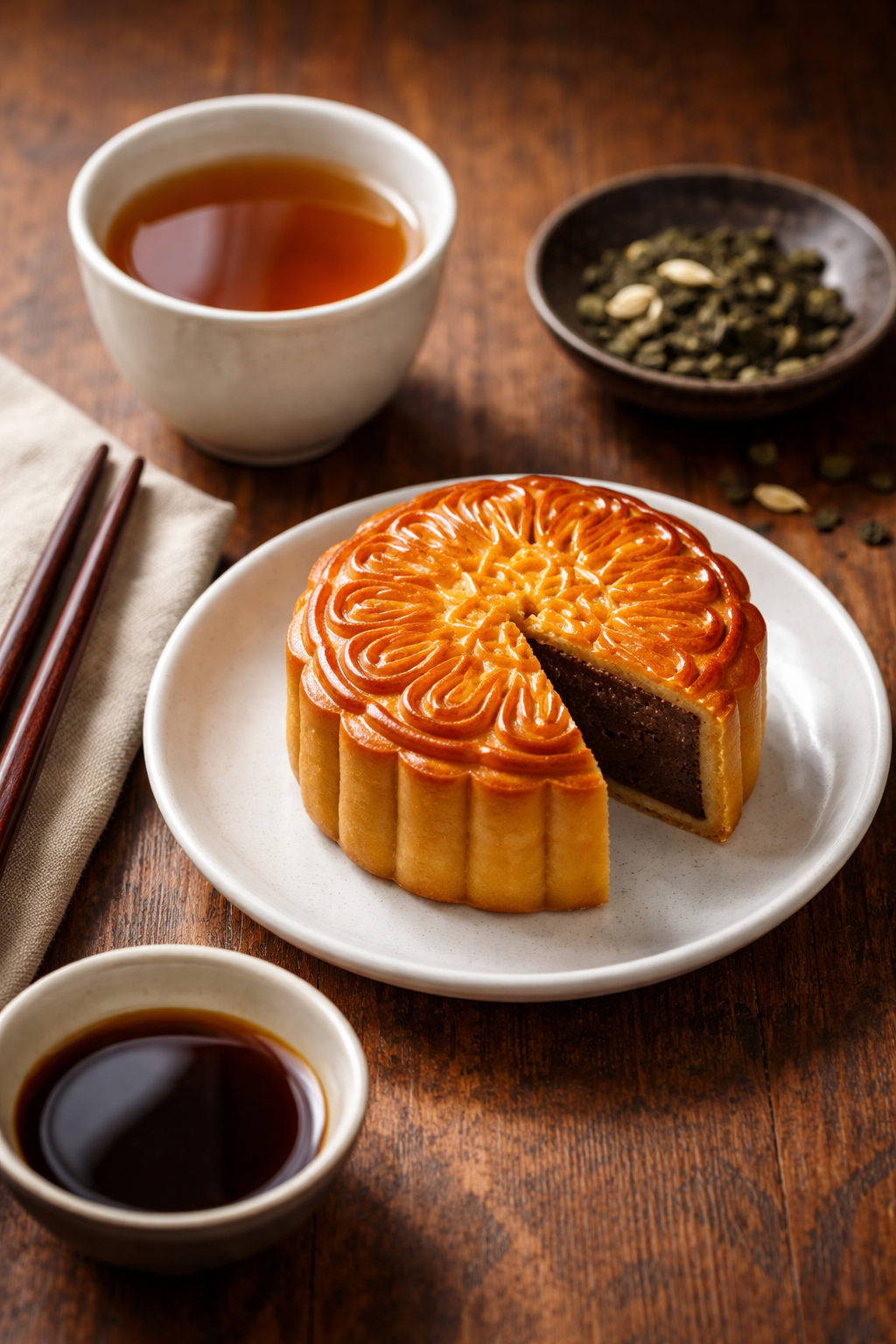
The salted egg yolk deserves special attention. When you cut into a moon cake and see that bright orange-yellow center, you are looking at a carefully preserved duck egg yolk. The salty richness balances the sweet filling perfectly. My aunt always says the egg yolk is the soul of a good moon cake.
What does a mooncake taste like? This question comes up often. Traditional moon cakes are dense, sweet, and rich. The lotus paste has a delicate, slightly floral flavor. Red bean paste tastes earthy and comforting. The salted egg yolk adds a savory punch that cuts through the sweetness. The texture is smooth and thick, almost fudge-like. You typically eat them in small slices because they are very filling.
Now let me introduce you to the ice moon cake. This modern variation changed the game completely. Instead of baking the pastry, ice moon cakes stay in the refrigerator or freezer. The skin is made from glutinous rice flour mixed with sugar and oil, creating a soft, chewy, mochi-like texture.
Ice moon cakes feel lighter and less sweet than traditional versions. The fillings can be creative and playful. I have tried flavors like:
- Green tea
- Mango
- Coffee
- Chocolate
- Durian (not my favorite, but many people love it)
- Taro
- Matcha red bean
The preparation for ice moon cakes differs completely from traditional methods. You do not need an oven. The dough stays pliable at room temperature, making it easier for beginners to shape. After assembling, you chill them for a few hours. They stay soft even when cold, unlike traditional baked versions that can become quite firm.
What does it mean to give someone a mooncake? Giving moon cakes shows respect, appreciation, and the desire to maintain connections. During the festival season, people give boxes of moon cakes to family members, friends, business partners, and colleagues. The gesture says “I value our relationship” without needing many words. My parents still exchange moon cakes with neighbors and old friends every year, even though we live far from our hometown.
For those wondering, does Costco sell mooncakes? Yes, many Costco locations carry moon cakes during the fall season, especially in areas with large Asian communities. They usually stock them in August and September. The selection might be limited compared to specialty Asian bakeries, but they offer good quality at reasonable prices.
A Simple Moon Cake Recipe to Try at Home
Ready to make your own? Here is a basic mooncake receta that I use when teaching friends. This moon cake recipe creates about 8 medium-sized moon cakes.
For the dough:
- 200g all-purpose flour
- 140g golden syrup or honey
- 50g vegetable oil
- 1 teaspoon alkaline water (or substitute with 1/4 teaspoon baking soda mixed with 1 teaspoon water)
For the filling:
- 400g lotus paste or red bean paste (you can buy this ready-made from Asian grocery stores)
- 8 salted egg yolks (optional but recommended)
Steps:
- Mix the golden syrup, oil, and alkaline water in a bowl until well combined
- Add flour gradually and stir until a soft dough forms
- Cover with plastic wrap and let rest for 2 hours at room temperature
- Divide the dough into 8 equal pieces (about 40g each)
- Divide the filling into 8 portions (about 50g each)
- If using egg yolks, press one into the center of each filling portion and wrap completely
- Flatten a dough piece, place filling in the center, and carefully wrap the dough around it
- Dust your moon cake mold with flour, press the filled dough ball into it, then push down firmly to create the pattern
- Place on a baking sheet and bake at 180°C (350°F) for 5 minutes
- Remove, brush with egg wash, then bake for another 10-12 minutes until golden brown
- Let cool completely, then store in an airtight container for 2-3 days before eating (this allows the flavors to develop)
This pastel de luna receta might seem intimidating at first. The wrapping technique takes practice. My first batch looked like lumpy potatoes rather than elegant pastries. But the taste was still wonderful, and my family appreciated the effort. Do not worry about perfection on your first try.

Exploring the Rich Variety of Moon Cake Styles Across Asia
Once you start diving into the world of moon cakes, you quickly realize that not all moon cakes are created equal. Each region has put its own spin on this beloved treat, and honestly, the differences can be pretty dramatic.
Let me take you on a little tour of what I have discovered through years of tasting and comparing. My cousin lives in Taiwan, and every year she sends me a box from her favorite bakery. The first time I received moon cake taiwan style, I was surprised by how different they looked from what I grew up with. Taiwan moon cakes tend to have a flakier, more pastry-like crust. The texture reminded me of French puff pastry but with that distinctly Asian sweetness.
The Taiwanese versions often feature pineapple filling, which you rarely find in traditional Cantonese-style cakes. That tangy-sweet combination works beautifully. Some bakeries in Taiwan also experiment with mochi-filled versions or even cheese flavors. I know cheese in a moon cake sounds weird, but trust me on this one. The slight saltiness against the sweet outer layer creates something unexpectedly delicious, kind of like how devil’s food cake cookies balance bitter chocolate with sugar.
Now, moon cake china encompasses several regional styles, each with passionate defenders. Cantonese moon cakes are probably what most people picture when they think of traditional moon cakes. These have that glossy, golden-brown skin I mentioned earlier. They are sweet, dense, and formal-looking with intricate patterns pressed into the top.
Beijing-style moon cakes are completely different animals. The crust is lighter and more cake-like. My friend from Beijing always argues that her hometown’s version is superior because they are not as heavy. She can eat a whole one without feeling like she needs to lie down afterward, which is a fair point.
Suzhou and Shanghai areas produce what they call “fresh meat moon cakes,” which technically are not even sweet. These savory versions contain seasoned pork and are served warm. The first time I tried one, I was standing in line at a tiny shop in Shanghai. Steam rose from the pastry as I bit in, and hot broth squirted out. I burned my tongue but kept eating anyway because it was that good. Think of them as sophisticated meat pies that happen to be round.
Here’s the thing about regional differences. They reflect local tastes and available ingredients. Southern China has easier access to lotus seeds, so lotus paste became the standard filling there. Northern regions with their wheat-growing traditions developed their cake-like crusts. Taiwan, with its Japanese colonial history, incorporated techniques from Japanese confectionery.
By the way, if you are into popular culture references, you might have heard about the mooncake serie. There’s actually a character named Mooncake in the animated show Final Space. The mooncake final space character is this adorable green alien creature that says its own name and becomes the protagonist’s loyal companion. I found it hilarious when that show came out because suddenly my non-Asian friends were asking me about moon cakes. The character has nothing to do with actual pastries, but it sparked some fun conversations.
Speaking of cultural crossovers, the moon cake chino term is what Spanish speakers use to describe Chinese moon cakes. When I lived in a neighborhood with a large Latino population, the local Asian bakery started labeling their products in both English and Spanish. They even experimented with dulce de leche filling one year, creating a fusion that somehow worked.
What Does a Mooncake Really Taste Like When You Try Different Types?
I have probably answered the basic question already, but let me get more specific about the tasting experience because it varies so much depending on which type you try.
Traditional Cantonese moon cakes with lotus paste are an acquired taste for many people. The first bite hits you with intense sweetness. The paste has this unique flavor that is hard to describe if you have never had lotus seeds before. Slightly nutty, a bit floral, definitely earthy. The texture is smooth but substantial. When you reach the salted egg yolk in the center, everything changes. That salty, rich yolk cuts through the sweetness like a knife.
I remember watching my American husband try his first moon cake at our wedding. We had them as favors because my mother insisted. He took a polite bite, and I watched his face go through several emotions. Confusion first, then surprise, then something like understanding. He told me later it was like tasting a story he did not know the language for. That actually made sense to me.
Red bean paste moon cakes taste more familiar to people who have tried Japanese sweets. The filling has a grainy, rustic quality. Less refined than lotus paste but somehow more comforting. My grandmother always chose red bean because she said lotus paste was too fancy for everyday eating.
Five kernel moon cakes are controversial. You either love them or think they are the fruitcake of the moon cake world. The texture is chunky with all those nuts and seeds. Some pieces have candied fruits that add chewiness. I personally enjoy them because every bite is different. You might get a piece of walnut, then some sesame, then a sweet bit of candied melon. It keeps things interesting.
The ice moon cake experience is totally different. Cold, refreshing, and much lighter. The mochi-like skin has a satisfying chew. When I bite into a green tea ice moon cake, I get this clean, slightly bitter flavor that is not overwhelming. The filling is often cream-based, making it feel more like eating a fancy truffle than a traditional pastry. On a hot September day, ice moon cakes make way more sense than the heavy baked versions. Similar to how a light dessert works better in summer than something dense like dobash cake with its rich chocolate layers.
Funny enough, my kids strongly prefer ice moon cakes. They think traditional ones are too sweet and strange. I try not to take it personally. Cultural tastes evolve, and maybe ice moon cakes are the gateway that leads to appreciation of the classic versions later.
Texture-wise, comparing traditional to ice moon cakes is like comparing a fudge brownie to a chocolate mousse. Both are chocolate, both are sweet, but the experience is completely different. Traditional moon cakes have substance and weight. You feel like you have eaten something significant. Ice moon cakes are ethereal and playful, almost like the difference between a formal dinner and a fun snack.
One time I tried a durian ice moon cake at an Asian dessert shop. Durian, if you do not know, is this Southeast Asian fruit that smells terrible but tastes incredible to people who love it. The moon cake captured that creamy, custardy durian flavor without the overwhelming smell. My friend refused to even sit near me while I ate it, which made me enjoy it even more.
The chocolate varieties that have become popular recently taste almost like Western desserts wearing Asian clothing. A chocolate moon cake with the traditional golden syrup skin creates this interesting East-meets-West situation. The technique is Chinese, but the flavor profile is international. I made some chocolate ones last year, using techniques I learned from making chocolate cake from scratch, and they turned out surprisingly well.
What surprises people most is the density. Even experienced dessert lovers are not prepared for how filling a single moon cake can be. I always tell people to cut them into thin wedges and share. Eating a whole one by yourself is possible but not advisable unless you want to skip your next meal.
The aftertaste lingers too. A good quality moon cake leaves this pleasant sweetness in your mouth that makes you want tea. That is why tea and moon cakes are inseparable during the festival. The tea cuts the richness and cleanses your palate between bites. My personal favorite pairing is oolong tea with lotus paste moon cakes. The floral notes complement each other beautifully.
Temperature also affects the experience. Traditional moon cakes can be eaten at room temperature or slightly warm. Warming them brings out the aroma and makes the filling softer. Ice moon cakes obviously need to stay cold, though they soften quickly once out of the fridge. Sometimes I think serving temperature matters as much as the ingredients themselves, just like how some desserts like certain layered cakes taste better chilled while others shine at room temperature.
If I had to sum it up, traditional moon cakes taste like concentrated celebration. Every element is intense and purposeful. Ice moon cakes taste like modern celebration, lighter and more accessible but still special. Both deserve their place at the festival table, and both tell you something about how food traditions adapt while staying rooted in their origins.
The Deep Cultural Roots and Meaning Behind Moon Cakes
Here’s something most people don’t realize when they bite into a moon cake. You’re not just eating a pastry. You’re participating in a tradition that stretches back over a thousand years, with stories layered inside those sweet fillings like hidden meanings waiting to be discovered.
The moon cake festival, formally called the Mid-Autumn Festival, ranks as one of the most important celebrations in Chinese culture, right up there with Lunar New Year. The festival dates back to the Tang Dynasty, though some historians trace moon-shaped offerings even further back to ancient moon worship practices. But the moon cake as we know it really took shape during the Yuan Dynasty, and that’s where my favorite story comes in.
Legend says that during Mongol rule in China, rebels used moon cakes to hide secret messages coordinating an uprising. They passed these cakes around as festival gifts, and hidden inside the lotus paste were slips of paper telling people when to revolt. Whether this actually happened or not, the story captures something essential about moon cakes. They’ve always been about more than food. They’re about connection, secrecy, solidarity, and home.
My uncle told me this story when I was a kid, and I remember slicing every moon cake extra carefully that year, hoping to find a secret message. I never did, obviously, but the idea stuck with me. Food carries messages even without paper notes inside. A moon cake china style pastry given to someone says things that might feel awkward to speak out loud.
The symbolism runs deep in every aspect. The round shape represents completeness and reunion. Chinese families place enormous importance on gathering together, and that circle embodies unity. When you cut a moon cake into pieces and share it, you’re literally dividing the whole to distribute among your people, but the circle remains conceptually complete because everyone gets a part. That might sound overly philosophical, but this kind of symbolism matters deeply during the festival.
The full moon itself carries powerful meaning in Chinese culture. It represents harmony, prosperity, and family togetherness. During the moon cake festival, families gather outside after dinner to admire the full moon. Kids run around with lanterns while adults sit drinking tea, eating moon cakes, and talking. My favorite childhood memories happened during these nights. The moon always seemed bigger and brighter during the festival, though that was probably just my imagination mixed with excitement.
Different countries celebrate this festival in their own ways. In Vietnam, they call it Tết Trung Thu, and children take center stage with lantern parades and lion dances. The moon cakes there often contain mung bean paste instead of lotus. Singapore and Malaysia celebrate with huge lantern displays and mooncake fairs where bakeries compete for the most creative flavors. I visited Singapore during festival time once, and the entire city seemed to glow with decorations.
In Hong Kong, the celebration includes fire dragon dances where a dragon made of incense sticks winds through the streets. Families in Korea celebrate Chuseok around the same time, though they eat songpyeon rice cakes instead of moon cakes. The common thread across all these celebrations is gratitude for harvest, appreciation for family, and taking time to slow down and observe nature’s beauty.
Taiwan has turned the festival into a massive barbecue event. Yes, seriously. In the 1980s, a successful advertising campaign somehow convinced everyone that Mid-Autumn Festival meant outdoor barbecuing, and now millions of Taiwanese people fire up grills alongside their moon cake taiwan boxes. My cousin says the streets smell like charcoal and grilled meat for days. Traditions evolve in unexpected ways.
Now let me tell you what really happens when you give someone moon cakes. The practical answer is that you’re acknowledging your relationship with them. But the emotional subtext varies based on context. When my parents give moon cakes to their bosses, it’s respectful and slightly formal. When my mom gives them to her sisters, it’s warm and assumes equality. When companies give them to employees, it’s supposed to show appreciation but sometimes feels perfunctory. When a young person gives them to elders, it demonstrates filial piety and respect.
I give moon cakes to my neighbors every year. We’re not Chinese, they’re not Chinese, but they’ve come to expect it. Last year I made ice moon cake varieties because I knew their kids would prefer them, and that choice itself communicated something. I was saying I know your family, I care about what you’d actually enjoy, this isn’t just obligation. The gesture matters more than the specific pastry, but the specific pastry shows how much thought went into the gesture.
Funny story about the gifting culture. Moon cake boxes have become status symbols in some circles. Luxury brands now make moon cakes with designer packaging that costs more than the actual food inside. I’ve seen boxes covered in leather, decorated with gold leaf, packaged in wooden cases that look like jewelry boxes. Some people collect these elaborate boxes and never even eat the cakes. My grandmother would find this absolutely ridiculous, and honestly, I kind of agree with her.
But here’s the thing about traditions adapting to modern life. Young people in cities don’t always have time or interest in complicated customs. They buy moon cakes online, send them as delivery gifts, choose trendy flavors like salted caramel or champagne truffle. Some traditional folks complain this misses the point. I think it shows the tradition is alive enough to evolve. As long as people still think of their loved ones during festival time and make some gesture of connection, the spirit survives even if the form changes.
The environmental impact of all this gifting has become a real issue. Mountains of excessive packaging end up in landfills every September. Some companies now offer simplified packaging or donate a portion of sales to environmental causes. I try to make homemade moon cakes when possible, using reusable containers for gifting. It takes more effort but feels more meaningful anyway, much like when I spend time on other homemade treats in the cakes and cupcakes category where personal touch matters more than store-bought perfection.
One aspect of the festival that doesn’t get talked about enough is how it creates space for remembering those who’ve passed. The full moon represents reunion, but for families with missing members, it also highlights absence. My grandmother always set out an extra moon cake for my grandfather after he died. Nobody ate it. It just sat there as an offering and acknowledgment. Those quiet rituals of remembrance matter just as much as the celebration.
Common Questions About Moon Cakes Answered
What are mooncakes made of?
Traditional moon cakes contain a dough made from flour, golden syrup, and alkaline water that creates the signature golden-brown skin. The filling typically consists of lotus seed paste, red bean paste, or five kernel mixture with nuts and seeds. Many include a salted duck egg yolk in the center representing the full moon. Modern ice moon cake varieties use glutinous rice flour for a chewy, mochi-like exterior with cream-based fillings in creative flavors like matcha, mango, or chocolate.
What does a mooncake taste like?
Traditional moon cakes are intensely sweet, dense, and rich with a smooth, fudge-like texture. Lotus paste has a delicate, slightly floral flavor while red bean paste tastes earthier and more rustic. The salted egg yolk provides a savory contrast that balances the sweetness. Ice moon cakes taste lighter and more refreshing with a chewy texture, similar to mochi. The experience varies dramatically depending on the type you try, but all moon cakes share a characteristic richness that makes them very filling.
What does it mean to give someone a mooncake?
Giving moon cakes expresses respect, appreciation, and the desire to maintain your relationship with that person. It’s a way of saying “I value our connection” without needing elaborate words. The gesture carries different weight depending on context, from formal business relationships to warm family bonds. During festival season, exchanging moon cakes strengthens social ties and honors tradition. The thought and care you put into selecting flavors or making them yourself adds additional layers of meaning to the gift.
Does Costco sell mooncakes?
Yes, many Costco locations stock moon cakes during late summer and early fall, typically from August through September. Availability depends on your location, with stores in areas having larger Asian communities more likely to carry them. The selection is usually limited to a few traditional varieties compared to specialty Asian bakeries, but the quality is generally good and the pricing is reasonable. Call your local Costco ahead of time to check if they carry them and when they expect stock to arrive.
Are there any health benefits to eating moon cakes?
Traditional moon cakes are quite high in sugar and calories, so they’re definitely a treat rather than health food. That said, lotus seeds contain protein, magnesium, and phosphorus, while red beans provide fiber and antioxidants. The nuts in five kernel varieties offer healthy fats and vitamins. Duck egg yolks contain iron and vitamin A. However, these benefits are offset by the high sugar content, so moon cakes should be eaten in moderation as an occasional indulgence rather than a regular snack.
How can I store moon cakes to keep them fresh?
Traditional baked moon cakes stay fresh at room temperature in an airtight container for about one week. Keep them away from direct sunlight and humidity. For longer storage, refrigerate them for up to two weeks or freeze for up to three months. Ice moon cakes must stay refrigerated and typically last about five days. Always check the packaging for specific storage instructions since different fillings have different requirements. Following proper food storage guidelines helps maintain quality and prevents spoilage, especially important with egg yolk fillings.
Can I find moon cakes outside of the moon cake festival?
While moon cakes are traditionally seasonal items sold during the Mid-Autumn Festival period, many Asian bakeries now offer them year-round due to popular demand. You’ll find the widest selection and freshest options from late August through September. Outside festival season, your best bet is established Chinese bakeries in larger cities or online retailers specializing in Asian foods. Some upscale hotels and restaurants serve moon cakes throughout the year, though often at premium prices compared to festival season.
Are there any vegan or gluten-free options for moon cakes?
Yes, vegan moon cakes are becoming increasingly available as dietary preferences evolve. These versions replace egg wash with plant-based alternatives and use vegetable oil instead of lard. The challenge is the egg yolk, but creative bakers substitute sweet potato or pumpkin centers. Gluten-free versions exist using rice flour or gluten-free flour blends, though the texture differs from traditional wheat-based dough. Specialty bakeries and online shops cater to these dietary needs, or you can adapt recipes at home using alternative ingredients.
How many calories are in a typical moon cake?
A standard traditional moon cake contains approximately 800-1000 calories, depending on size and filling. That’s why we traditionally slice them into thin wedges and share rather than eating whole ones individually. Ice moon cakes tend to be slightly lower in calories, ranging from 600-800 calories each, but they’re still quite calorie-dense. One moon cake can contain your entire daily recommended sugar intake. Enjoying them mindfully and in moderation makes sense, treating them as special occasion foods rather than everyday snacks.
What’s the best way to serve moon cakes?
Slice traditional moon cakes into thin wedges, typically 8-12 pieces per cake, and serve at room temperature or slightly warmed. Pair them with hot Chinese tea like oolong, pu-erh, or jasmine tea to cut the richness and cleanse your palate between bites. Ice moon cakes should be served chilled but allowed to sit at room temperature for a few minutes to soften slightly before eating. Present them on a nice plate, offer small forks or picks, and encourage sharing. The communal aspect of dividing and sharing enhances the cultural experience beyond just the taste.
Making or sharing moon cakes connects you to centuries of tradition while creating your own memories. Whether you stick with traditional pastel de luna receta methods or experiment with modern flavors, the act of participating in this food culture matters more than perfection. I hope this journey through the world of moon cakes inspires you to seek them out, make your own, or simply appreciate the stories baked into each one. Happy moon gazing, and may your celebrations be filled with sweetness and good company.
Equipment
- Mixing Bowl
- Plastic Wrap
- Baking Sheet
- Moon Cake Mold
- Oven
Ingredients
- 200 g all-purpose flour
- 140 g golden syrup or honey
- 50 g vegetable oil
- 1 teaspoon alkaline water
- 400 g lotus paste or red bean paste ready-made from Asian grocery stores
- 8 salted egg yolks optional but recommended
Instructions
- Mix the golden syrup, oil, and alkaline water in a bowl until well combined.
- Gradually add flour and stir until a soft dough forms.
- Cover with plastic wrap and let rest for 2 hours at room temperature.
- Divide the dough into 8 equal pieces (about 40g each).
- Divide the filling into 8 portions (about 50g each).
- If using egg yolks, press one into the center of each filling portion and wrap completely.
- Flatten a dough piece, place filling in the center, and carefully wrap the dough around it.
- Dust your moon cake mold with flour, press the filled dough ball into it, then push down firmly to create the pattern.
- Place on a baking sheet and bake at 180°C (350°F) for 5 minutes.
- Remove, brush with egg wash, then bake for another 10-12 minutes until golden brown.
- Let cool completely, then store in an airtight container for 2-3 days before eating (this allows the flavors to develop).
Notes
Nutrition

Hello! I’m Sarah Mitchell, and I’m passionate about bringing creativity and innovation to baking. My love for baking started in high school when I first tried my hand at decorating cupcakes for a class project. What began as a fun hobby quickly became a full-time passion. I’ve spent the past decade working in bakeries and dessert shops, honing my skills in everything from simple cookies to intricate wedding cakes.
After working in some of the top bakeries across the country, I realized that baking was about more than just following recipes — it was about infusing your personality into each creation. At BakingSecret.com, I love creating recipes that push boundaries while staying true to the heart of classic baking. I specialize in creating delicious and visually stunning pastries that will wow your guests.
When I’m not baking, I enjoy teaching baking classes, trying out new cake decoration techniques, and traveling to find inspiration in global dessert traditions. I’m so excited to share my tips and tricks with you to help elevate your baking game!